
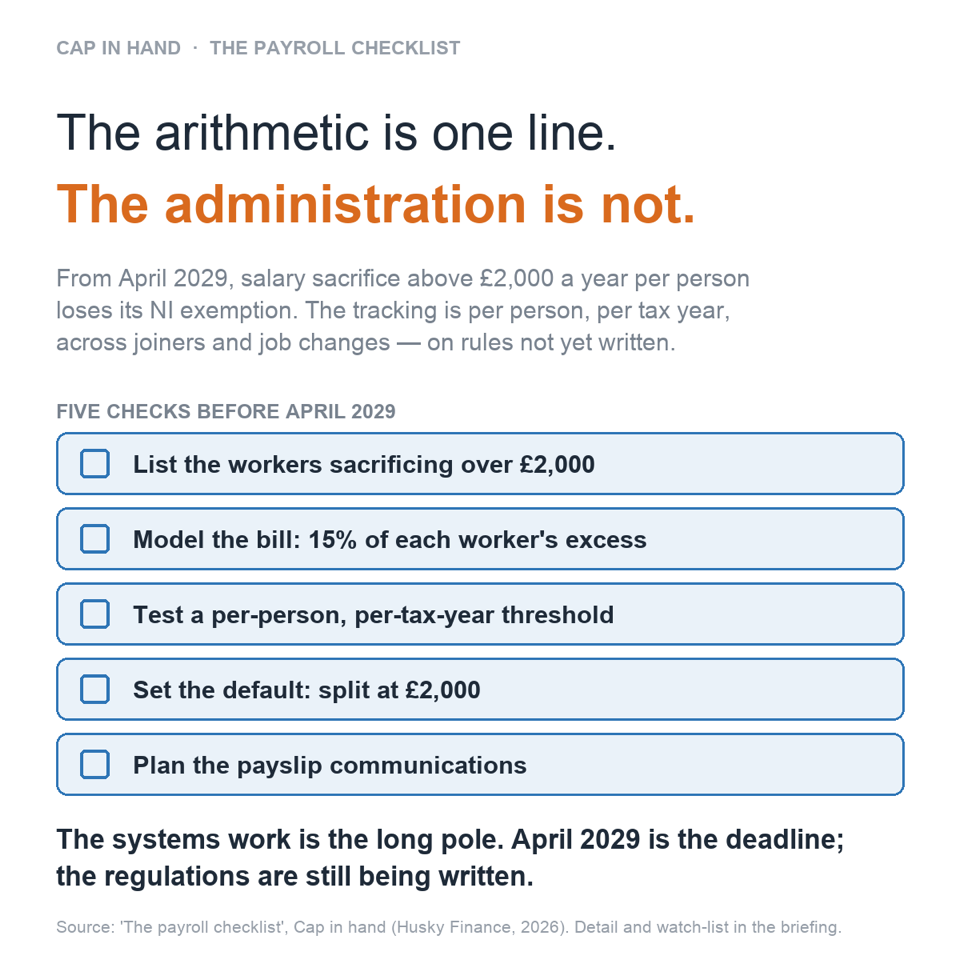
Cap in Hand – Payroll Checklist
From April 2029, salary-sacrificed pension contributions above £2,000 a year per person lose their National Insurance exemption. The arithmetic is one line; the administration is not. What payroll teams, bureaus and advisers need in place before April 2029 — and what the rules have not yet decided.
Five checks before April 2029
- List the exposed: every worker sacrificing more than £2,000 a year. One payroll query answers it, and expect most scheme users to appear: nearly four in five do in the records behind the full paper.
- Model the bill: roughly 15% of each worker’s excess above £2,000 falls to the employer from April 2029; the worker’s own charge on the excess is 2% (8% for pay under £50,270).
- Check the system can hold a per-person, per-tax-year threshold: the £2,000 is an annual allowance that resets each April, so the accumulator, the year-end reset and behaviour across payroll migrations all need testing before 2029.
- Decide the default response now: a split — salary exchange to £2,000, the remainder as an ordinary employee contribution — is payroll configuration rather than a contract change, though how much work depends on the payroll system.
- Plan the communications: affected payslips change in April 2029 even where nothing else does. A worker who first hears of the cap from a payslip is a complaint; a sacrifice that quietly lapses is a lost pension.
What the rules have not decided
The open question is portability. The Act sets the £2,000 per tax year and leaves the operating mechanics to regulations still to be written. If the threshold follows the person rather than the employment, a new employer must know how much of a mid-year joiner’s allowance is already used — information the standard starter process does not carry, and which would take changes to payroll software and to what HMRC shares with it. Until the regulations land, build for both readings.
Two further margins to watch: the cap is set in cash terms for 2029–30 and is not indexed, so each year’s pay growth pushes more workers across it; and multiple employments, mid-year joiners and leavers all interact with an annual threshold in ways the guidance has not yet addressed. The safe assumption is that the tracking burden lands on payroll.
The split, in practice
The first £2,000 of sacrifice keeps its full NI advantage indefinitely, so the default that preserves most value for least admin is the split: exchange to the cap, with the remainder paid as an ordinary employee contribution with income-tax relief intact. Only the further step — moving the remainder into ordinary employer contributions, which restores the NI saving in full — needs contracts reopened. Firms have until April 2029; the systems work is the long pole.
This takeaway accompanies the full analysis: ‘Cap in hand: who bears the £2,000 cap on salary-sacrificed pensions’, Husky Finance, August 2026 (draft). All figures are sourced there; person-level results come from Husky platform records of 10,538 workers at 965 small firms (159 of them in the salary-exchange analysis), February 2025. No personal data appears in either document.
Get started
Register with Husky to get started or have a chat with our team to understand the benefits.